EBO Connector Explained: AI Data Centers Are Starting to Rethink How Fiber Gets Plugged In
By HENGXANG Firm · Published on August 17, 2026 · Updated on September 30, 2026
Last updated: September 30, 2026
TL;DR: An EBO connector (Expanded Beam Optical connector) uses tiny lenses to widen each light beam so it can jump a small air gap between two ferrules, with no polished end-face contact. The EBO connector accepts slightly higher typical insertion loss (about 0.35 dB single-mode) in return for far better tolerance to dust, repeated plugging, and field handling. That trade is why AI data centers like Microsoft Azure now deploy it. Below: the optics, the specs, and the adoption outlook.
An EBO connector is a fiber optic connector built on Expanded Beam Optical technology: tiny lenses inside the ferrule widen each light beam so it crosses a small air gap between two plugs, with no polished end-face contact. 3M created the current version and has shipped it in volume since late 2024, and vendors including Molex, Rosenberger, and Sumitomo Electric now sell their own EBO connector lines in fiber counts from 12 up to 192 per plug. Versus an MPO-style physical contact connector, the EBO connector accepts slightly higher insertion loss (0.35 dB typical, single-mode) in exchange for far better tolerance to dust and repeated plugging, which is why AI data centers including Microsoft Azure now deploy it to install fiber faster and clean it less. In this guide, our engineers explain how it works, the real specs, the MPO comparison, and how ready it is to buy today.
Why the sudden attention? Here is an uncomfortable truth from the factory floor: in a modern AI data center, the smallest part can cause the biggest problem. A speck of dust sitting on a physical contact end face can degrade a link that carries traffic between thousands of GPUs. Meanwhile, one newly announced expanded beam design squeezes 3,456 fibers into a single 1RU panel for AI scale-up networks, and Microsoft has made Azure the first hyperscale cloud to deploy 3M's Expanded Beam Optical technology. When fiber counts and stakes climb like that, how fiber gets plugged in stops being a detail and becomes a strategy.
A quick introduction before we dig in. We are HENGXANG, a fiber optic manufacturer based in Zhejiang, China. We have built connectors, patch cords, and cable assemblies for more than 25 years, including the MPO products that EBO is now challenging. In this guide, we will explain what an EBO connector does, how it differs from MPO, which specs actually matter, and how far along the technology really is. No marketing fog, just what an experienced manufacturer sees.
What Is an EBO Connector, in Plain Words?
An EBO connector is a multi-fiber optical connector that passes light through tiny lenses inside each ferrule. The lenses widen every needle-thin beam into a broader, parallel beam that jumps a small gap between two ferrules, with no polished end-face contact. The goal is not the lowest loss; it is tolerance to dust, repeated plugging, and rough field handling.
Here is the whole story in one table before the details:
| Quick fact | Detail |
|---|---|
| Stands for | Expanded Beam Optical |
| Origin | 3M first showed the EBO ferrule and connector system in 2019 |
| Who makes it | 3M, plus Molex (VersaBeam), Rosenberger, Sumitomo Electric, and roughly 60 MSA member companies |
| Fiber counts | 12, 16, 144, or 192 fibers per connector, depending on vendor |
| Key specs (3M MP12) | Single-mode: 0.35 dB typical insertion loss, 55 dB minimum return loss; multimode: 0.20 dB typical |
| Durability | 3M publishes stability data across 100 mating cycles; some vendors rate expanded beam ferrules beyond 10,000 cycles |
| Marquee user | Microsoft Azure, the first announced hyperscale deployment |
| Status | In volume production since late 2024; capacity more than doubling in 2026; MSA specifications in progress |
EBO stands for Expanded Beam Optical. The easiest way to picture it is with two water hoses. A traditional fiber connection works like two thin pipes pressed tightly together, mouth to mouth. If the pipes drift apart even slightly, water leaks everywhere. EBO works more like a pair of nozzles. The first nozzle turns a thin, fast stream into a wide, steady column of water. That column travels a short distance through the air. The second nozzle catches it and funnels it back into a pipe.
Now swap the water for light and the nozzles for tiny lenses. Inside an EBO ferrule (the precision-molded block that holds the fibers), each fiber sits in front of a small lens. Light leaving a fiber spreads quickly, like water from a pinhole. The lens grabs that light and turns it into a collimated beam. Collimated just means the light rays travel in parallel, so the beam keeps roughly the same width over a short distance instead of fanning out.
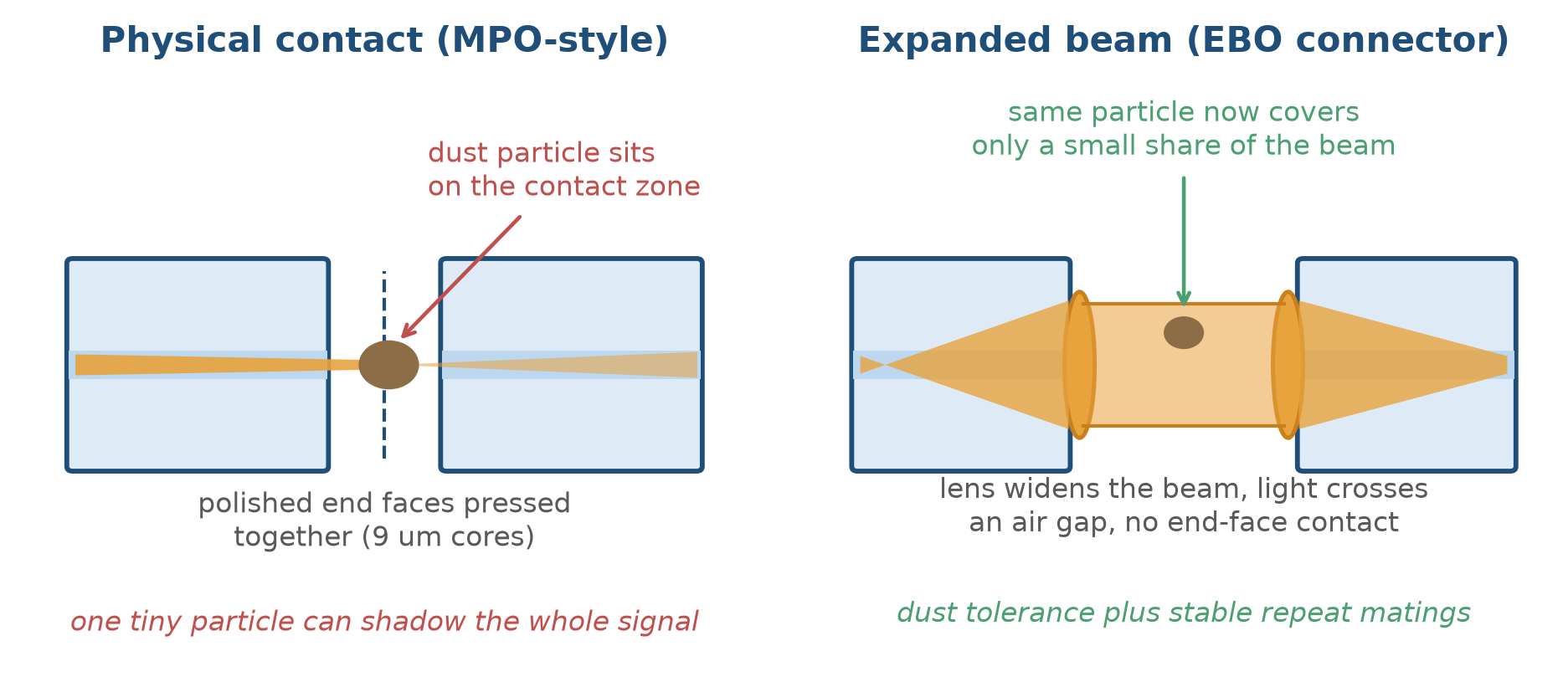
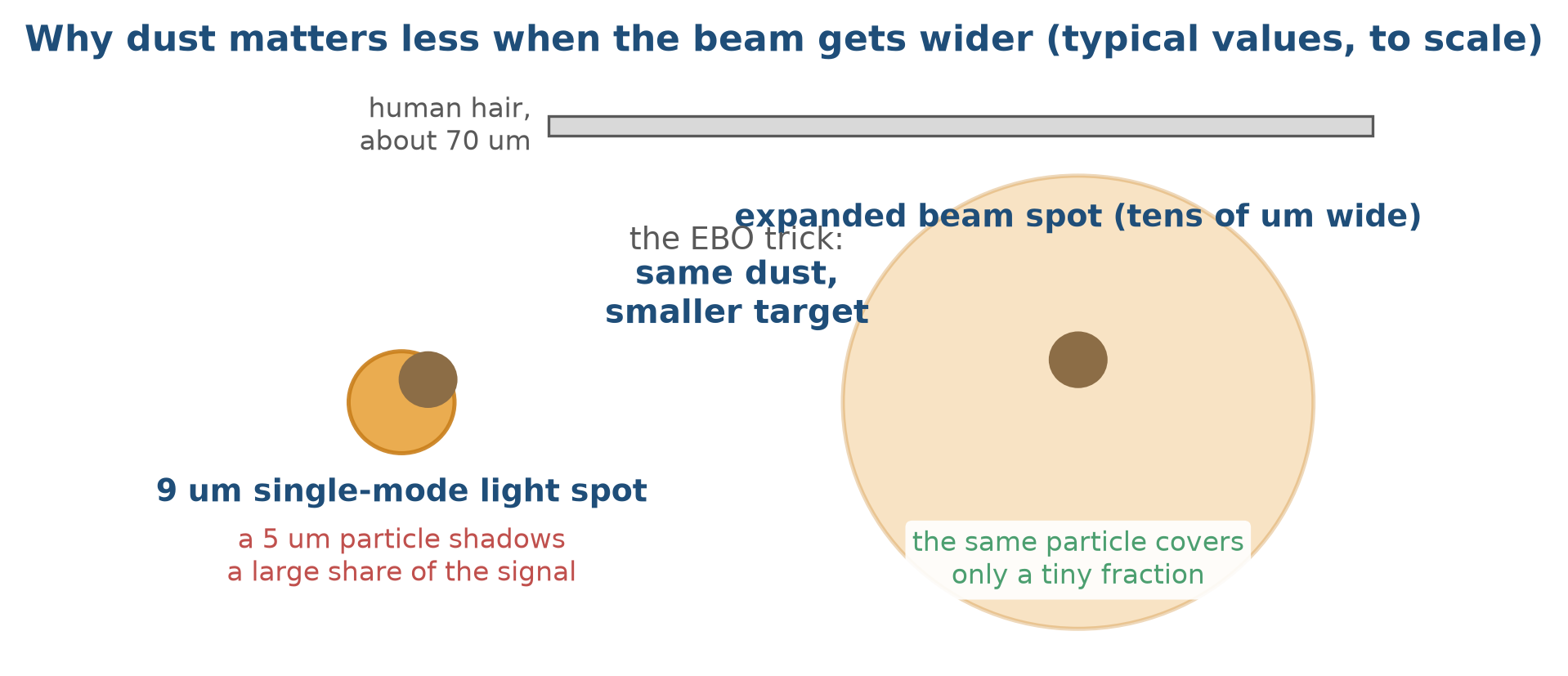
Why bother with all that optics? Because of size. The light-carrying core of a single-mode fiber is only about 9 microns wide. That is smaller than a red blood cell. A dust particle that you would never notice can cover a meaningful share of that spot and block or scatter the signal.
Widening the beam changes the math. If the lens expands the light spot to many times its original size, that same dust particle now covers a much smaller fraction of the beam. The connection still prefers to be clean, but a single grain of dirt no longer sits right on top of the signal path. That is the whole trick behind "expanded beam dust tolerance," and it is the logic 3M uses across its EBO connector kit family, which spans 12, 16, and 144 fiber versions.
Expanded beam designs are not new, by the way. Defense and outdoor networks have trusted them for decades, because mud, vibration, and rain make polished physical contact impractical in the field. What is new is pointing this approach at the high-fiber-count, cost-hungry world of AI data centers. 3M first showed its EBO ferrule and connector system publicly back in 2019. Since then it has moved from demo to deployment, including inside Microsoft's Azure data centers as part of a strategic AI infrastructure partnership announced in July 2026.
If you work with our fiber optic connector range today, you already know the families it sits beside: LC, SC, FC, and MPO/MTP styles. Think of EBO as a new cousin with a completely different inner life.
Does the trick work the same for every fiber type? Mostly yes, with one nuance. Multimode fiber carries light in a much larger core, about 50 microns across, so its starting spot is already wider and more forgiving. That is part of why the multimode EBO numbers you will see later are lower, at 0.20 dB typical loss. Single-mode fiber, with its roughly 9-micron core, benefits even more from expansion, but its tighter geometry demands more precise lens alignment. In practice, single-mode versions are where the manufacturing difficulty concentrates, and also where long-reach hyperscale links direct most of their interest.
One more mental model before we move on. Imagine shining a laser pointer through a keyhole from across the room. A thin beam must hit the hole almost perfectly. A wide flashlight beam covers the hole easily, even if your hand shakes a little. EBO turns every connection from a laser pointer into a flashlight. You give up some intensity, which shows up as insertion loss, and you gain enormous tolerance for imperfect conditions, which shows up as maintainability.
Want the full deep dive? This hour-long webinar with 3M and Rosenberger walks through how expanded beam optics keep high-speed fiber interconnects reliable, including the co-packaged optics scenarios we will touch on later:
Why Do Traditional Multi-Fiber Connectors Fear Dirt More Than Ever?
MPO-style connectors transmit light by pressing two rows of polished fiber end faces together with micron-level precision. Each single-mode core is only about 9 microns wide, so one nearly invisible particle in the wrong spot can degrade insertion loss, return loss, or stability. The more connections a site has, the bigger this risk grows.
Start with how an MPO connector actually works, because the weakness is baked into the strength. An MPO ferrule lines up 8, 12, 16, or more fibers in a precise row. A spring pushes the two ferrules together so the polished fiber end faces touch directly. Light jumps from one glass core into the matching core across that touch point. This is called physical contact, and when it is clean it performs beautifully.
The catch is what "physical contact" demands. The light-carrying zone of a single-mode fiber, called the mode field, is roughly 9 microns across. For comparison, a human hair is about 70 microns across. The contact zone is a tiny bulls-eye, and anything sitting on it matters enormously. Dust, skin oil, a fiber fragment, or a micro-scratch from a previous dirty mating can all raise insertion loss (light lost at the joint), wreck return loss (light reflected back toward the source), or make the connection unstable.
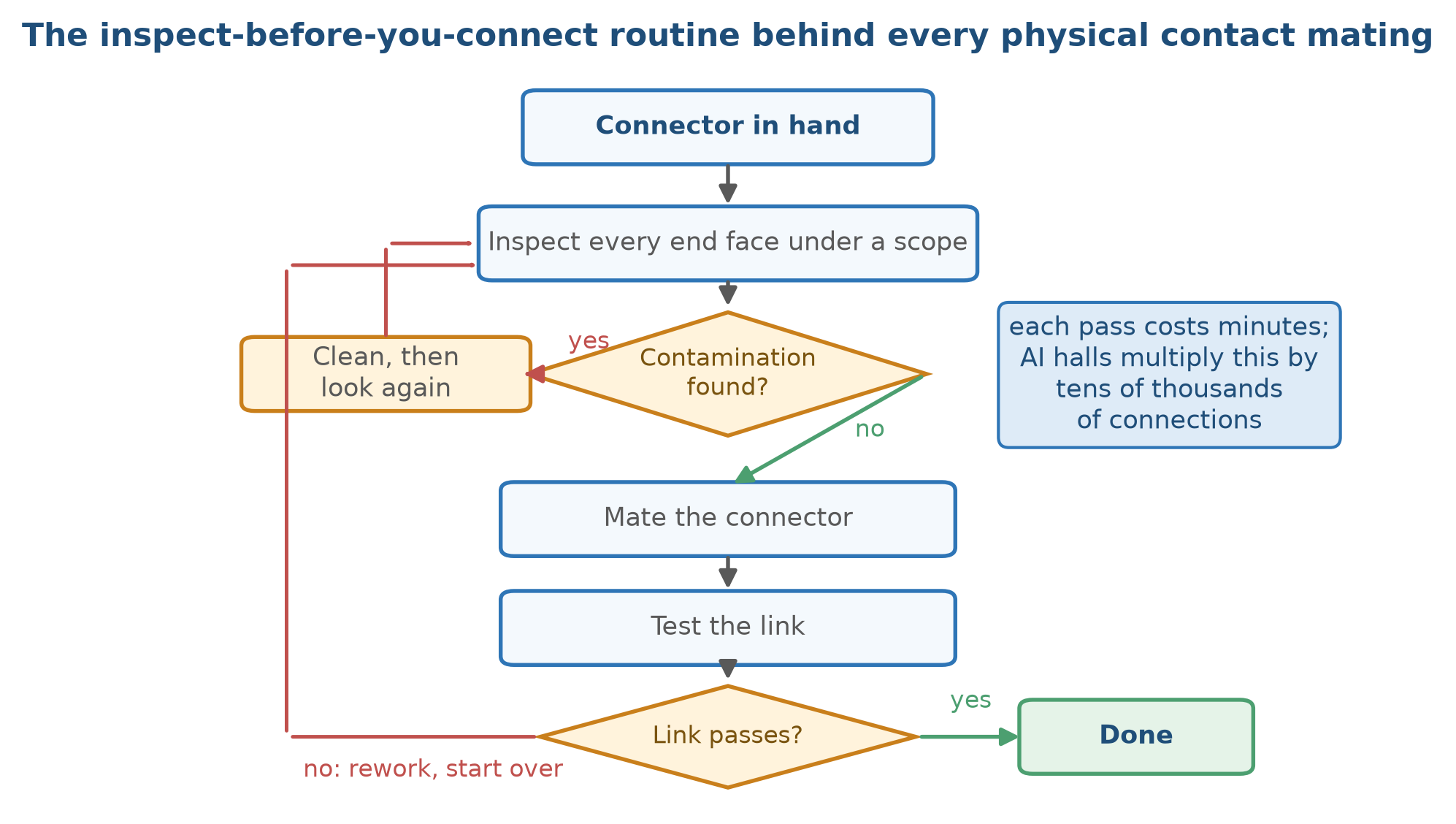
So plugging in fiber was never just plugging in. The accepted field discipline, which test equipment makers like VIAVI teach as "inspect before you connect," is a loop: inspect the end face under a scope, clean it if needed, inspect again to confirm, then mate and test. If the test fails, you unplug, clean, and start the loop over. Each pass takes minutes, and there is no honest way to skip it. A dirty connection does not always fail on day one; it can degrade slowly and fail during a production workload.
Walk into a real deployment and the loop looks like this. A technician finds the right port, clicks an inspection scope onto the connector (or loads the MPO into an automated probe), studies 12 end faces on a screen, and checks them against pass criteria: no particles, no film, no scratches in the core zone. If any fiber fails, out comes a one-click dry cleaner or a lint-free wipe and solvent, followed by another inspection pass. Only then does the connector go in, and even then a test set may verify the whole link. Experienced crews do it fast, but nobody does it free, and every rework roughly doubles the cost of that connection point.
There is a human side too. Every one of those steps depends on a trained eye deciding the end face is clean enough. Turnover, fatigue, and schedule pressure quietly erode that discipline, which is why contamination remains one of the most common root causes of fiber link trouble in the field. The industry's answer so far has been better inspection tools and stricter procedures. EBO's answer is to need less of the procedure in the first place.
MPO cleaning and inspection is genuinely tricky in practice, and this short course from Fluke Networks shows why: the density of the ferrule, what contamination looks like on the scope, and where crews usually go wrong. It is exactly the workflow EBO is designed to shorten:
Here is where scale turns a chore into a crisis. When a network has a few hundred connections, the loop is tedious but manageable. AI data centers are heading toward tens of thousands of multi-fiber connections per campus, and every one of them is a place where dirt, oil, or damage can hide. The labor, the schedule slip, and the rework all multiply. And the stakes of a failed link keep climbing: recent industry analysis puts the average cost of unplanned data center downtime at about $9,000 per minute, or $540,000 per hour.
This is the background you need to understand EBO. The technology was not invented because traditional connectors cannot pass light; they pass it very well. It exists because cleaning, inspecting, maintaining, and repeatedly replugging huge numbers of physical contact joints has become the expensive part. Any technology that makes each connection point faster to install and less fragile to handle is really selling time and uptime.
How Does the 3M EBO Connection Process Work in Four Steps?
Inside a 3M EBO connection, light leaves the fiber and hits a lens that expands it into a parallel beam. The beam crosses the air gap between the two aligned ferrules with no end-face contact, and a matching lens refocuses it into the receiving fiber. The hard part moves inside the ferrule, away from the end face.
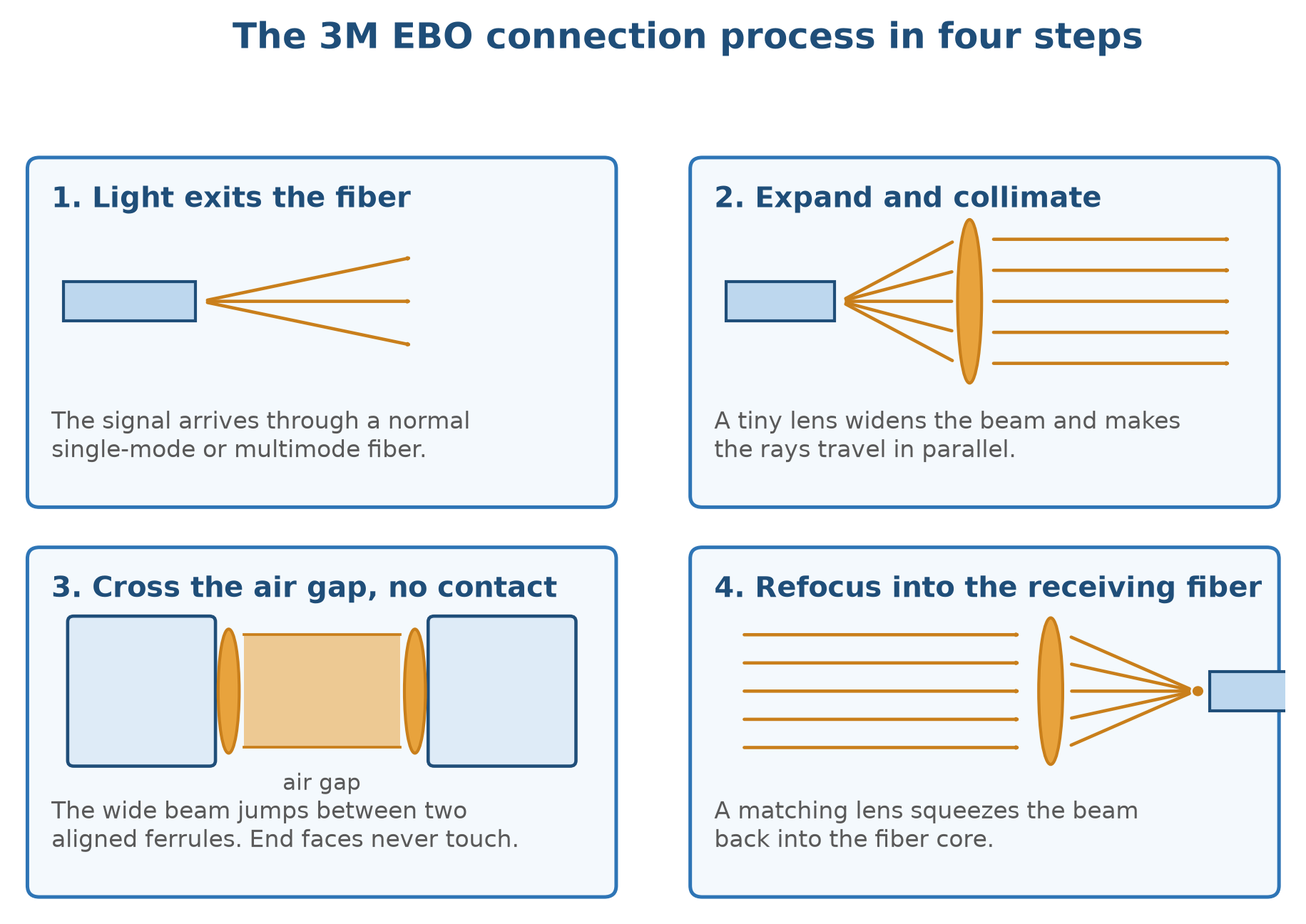
Here is the same journey in four steps, the way 3M's system actually processes the light.
Step 1: Light leaves the fiber. The signal starts as ordinary light traveling in a single-mode or multimode fiber, exactly as it would in any network. The fiber terminates inside the EBO ferrule, in front of the optical structure. Nothing exotic has happened yet.
Step 2: The beam gets expanded and collimated. The ferrule's internal optics, in essence a tiny lens matched to each fiber, take the small diverging spot of light and widen it into a beam many times larger. The lens also collimates the beam, meaning the rays are bent to travel in parallel. A wide, parallel beam can cross a gap without spreading uselessly or losing much energy.
Step 3: The beam crosses the connection interface without contact. The two ferrules are pushed into precise mechanical alignment, facing each other. The expanded beam jumps the small air gap between them. Critically, the two fiber end faces never touch each other. There is no polished glass-to-glass interface to protect, and no contact zone for debris to sit directly on. Molex, whose VersaBeam line uses this same lens-based approach, sells expanded beam connectors aimed squarely at these dense, low-maintenance links.
Step 4: The beam is refocused into the receiving fiber. On the far side, a mirror-image optical structure receives the wide beam and squeezes it back down to the tiny spot that fits into the receiving fiber's core. If the alignment is good, most of the light couples in, and the link carries on as if nothing unusual happened.
What can still go wrong? The air gap itself is harmless to the light, but the lens surfaces can still collect a heavy film or a fingerprint, so dust caps and cleaning discipline still exist in EBO workflows. Alignment is also still king: if the two ferrules sit at a slight angle or offset, the wide beam arrives at the receiving lens off-center and some light spills past the fiber. That is why the mechanical guides, and the molding precision behind them, carry so much of the design effort. The expanded beam forgives dust far more easily than it forgives misalignment.
Notice what this architecture quietly does to the engineering problem. A traditional connector lives or dies by end-face contact precision: the polish quality, the cleanliness, the spring force holding the two faces together. EBO trades that problem for a different set: micro-optic design inside the ferrule, molding precision for hundreds of thousands of identical lens arrays, and alignment of the fiber array to the lens array.
We point this out because it matters for expectations. The end face is no longer the fragile part, which is the entire maintenance argument. But the difficulty did not vanish. It moved into manufacturing, where it has to be solved once, in a clean factory, instead of being solved over and over in the field. For a connector maker like us, that is a familiar trade: spend more precision at the source so the customer spends less precision at installation.
How Is an EBO Connector Different from MPO and Physical Contact?
Physical contact (PC) connectors, including MPO, pass light by pressing polished fiber end faces directly together. An EBO connector instead widens the beam with lenses so it crosses a small gap. That makes EBO less sensitive to dust and wear, but not maintenance-free, and its typical insertion loss runs slightly higher than a clean, well-polished PC connection.
Let's put the two approaches side by side, feature by feature.
| What you care about | MPO / physical contact | 3M EBO (expanded beam) |
|---|---|---|
| How light crosses | Polished fiber end faces pressed together | Lens widens the beam; it jumps a small air gap |
| Dust sensitivity | High; one particle on the contact zone can hurt the link | Lower; the same particle covers a smaller share of a wider beam |
| Cleaning and inspection | Inspect, clean, re-inspect before nearly every mating | Fewer cycles needed, but cleanliness still matters |
| Repeated plugging | End faces can wear or get scratched over matings | No end-face contact, so performance holds steadier across matings |
| Ferrule geometry | Male and female versions (pinned and unpinned) | MP12 ferrule is genderless; either side mates with either side |
| Typical insertion loss | Very low when perfectly clean and polished | Slightly higher (3M data: 0.35 dB typical single-mode) |
| Where it shines | Clean rooms, low mating counts, cost-sensitive builds | Huge connection counts, fast builds, frequent replugs, dusty sites |
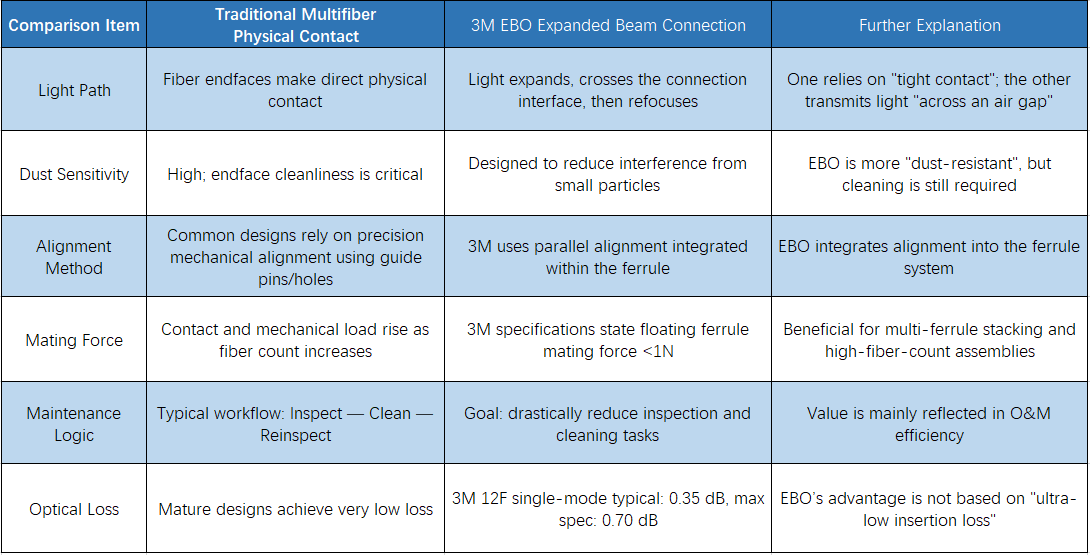
A few of those rows deserve a closer look.
The genderless ferrule is a quiet but practical detail. MPO systems need male (pinned) and female (unpinned) connectors to pair correctly, which adds a layer of inventory and polarity planning. 3M's MP12 connector supports 12 single-mode or multimode fibers with a ferrule geometry that has no male or female distinction, so any plug can mate with any plug.
The inventory effect is bigger than it sounds. In MPO worlds, installers must track male and female variants, polarity methods A, B, and C, and pinned versus unpinned adapters, then order precisely the right mix for every row of racks. A genderless geometry removes one whole axis of that planning. Anything that simplifies what a technician must remember at 2 a.m. tends to reduce errors, and errors, not parts prices, are what expensive installs are made of.
The insertion loss row is where shoppers often stop reading, and they shouldn't. We will spend a full section on that below, because a single number hides the maintenance story.
And the fiber counts are evolving fast on both sides. MPO is a mature ecosystem with vast tooling and test support. EBO is catching up quickly: Molex's VersaBeam family already integrates 12, 16, 144, or 192 fibers into single connectors, a range that now overlaps and exceeds standard MPO counts. If you want to see how deep today's MPO world already goes, browse our MPO patch cords and pigtails or this push-pull MPO connector kit designed for exactly the tight, high-mating-count spots where handling ergonomics start to matter.
One caveat, and we want to state it as plainly as the raw engineering allows: EBO's dust resistance is not a license to get sloppy. Any optical connection system needs sensible cleanliness control. The genuine value is that EBO lowers the sensitivity to small particles and removes the fragile end-face contact, which cuts down how often field crews must inspect, clean, and rework connections. Less fear of dirt is not the same as no dirt.
Which EBO Parameters Actually Matter (Beyond Insertion Loss)?
3M's 12-fiber data sheet shows single-mode EBO at 1310 nm with 0.35 dB typical (0.70 dB max) insertion loss and at least 55 dB return loss; multimode at 850 nm with 0.20 dB typical (0.30 dB max). The numbers that matter more: stability after 100 matings, dust behavior, mating force at high fiber counts, and time saved per connection.
First, a 30-second refresher on the units, because datasheets assume you speak decibel. Insertion loss (IL) measures how much light disappears at the connection; lower is better. Return loss (RL) measures how much light bounces back toward the source; higher is better, because reflected light corrupts laser-based transmitters. Each 3 dB of insertion loss means roughly half the light is gone, so in a link budget, every tenth of a dB counts.
Here are the headline specs from 3M's published product data sheet for its Expanded Beam Optical (EBO) Connector Kit, MP12:
| Parameter | Single-mode | Multimode |
|---|---|---|
| Operating wavelength | 1310 nm | 850 nm |
| Insertion loss, typical | 0.35 dB | 0.20 dB |
| Insertion loss, maximum | 0.70 dB | 0.30 dB |
| Return loss, minimum | 55 dB | not specified the same way |
| Fiber count per ferrule | 12 | 12 |
| Ferrule geometry | Genderless | Genderless |
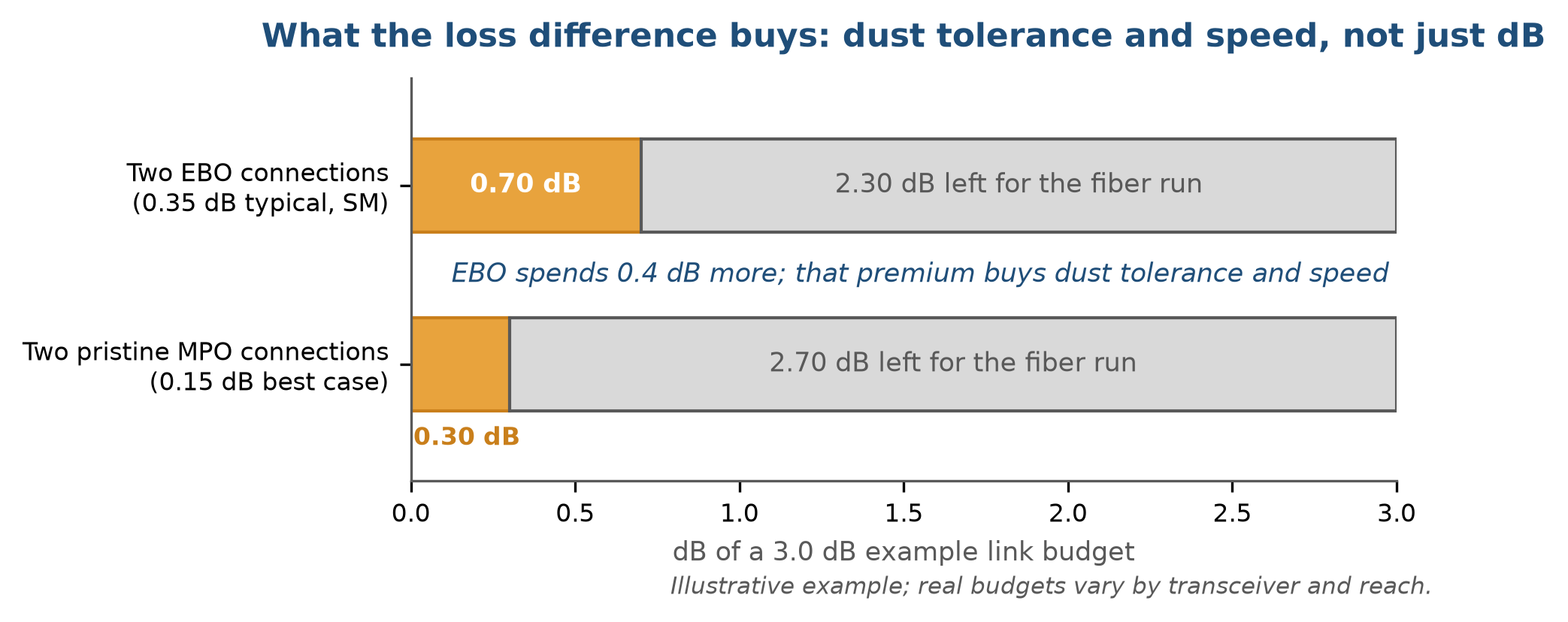
Read honestly, these numbers tell you something important: EBO is not trying to win the "lowest single-connection loss" contest. A pristine, professionally cleaned MPO assembly can post lower typical insertion loss than 0.35 dB. If your only criterion is the best-case loss on a bench, physical contact still has an edge.
So what should a data center buyer actually fixate on? Four things, in our view.
1. Stability after repeated matings. 3M's public materials include data showing how insertion loss and return loss behave across 100 mating cycles on a 12-fiber ferrule, precisely to demonstrate this repeatability. For a real data center, a connector that measures brilliantly once but drifts after the tenth replug is worth less than one that stays boring and stable for a hundred. Rugged expanded beam designs go much further: Rosenberger OSI rates its EBO ferrules for more than 10,000 mating cycles with roughly 0.7 N of plug force, figures inherited from decades of expanded beam service in outdoor and defense networks.
2. Failure probability and cleaning frequency around dust. The right question is not "what is the loss in a clean lab?" It is "how often do connections fail or need attention in a normal, imperfectly clean environment?" This is where the expanded beam architecture is designed to pay off.
3. Mating force and mechanical tolerance at high fiber counts. As fiber counts climb, plug force, guide pin precision, and tolerance stack-ups get harder to control. EBO designs put serious effort into low insertion force and stable multi-ferrule stacking, because that is what high-density AI racks will demand.
4. Time and labor saved per connection point at scale. Multiply any per-connection saving by tens of thousands of connections and a deployment starts looking completely different. We will quantify this in the next section.
To make the trade concrete, run a toy link budget. Suppose a 1310 nm link can afford 3 dB of total loss between transceivers. At 0.35 dB per EBO connection, two connections consume 0.7 dB and leave 2.3 dB for the fiber run and everything else. At a flawless 0.15 dB per MPO connection, you would save 0.4 dB along the way. That margin genuinely matters on long links, and it is why EBO conversations start at short-reach, high-density interconnect, where loss budgets are generous. The point is not that the loss difference is imaginary. The point is that a link budget is only one line in the total cost of owning tens of thousands of connections.
There is a testing angle here too, and it is one we live daily. Our production lines run 100% optical testing on every connector before shipment, with in-line interferometer checks on ferrule end faces, and our internal benchmarks exceed the IEC 61300 and Telcordia GR-326 minimums listed among our certifications. That experience taught us the same lesson the EBO data implies: for real deployments, repeatability and maintainability are worth at least as much as a one-time lowest loss figure.
Why Are AI Data Centers Taking EBO Seriously?
AI clusters need far more optical links than classic cloud data centers, because GPU groups, switches, and racks all talk over fiber at 400G, 800G, and 1.6T speeds. Once a campus holds tens of thousands of connections, handling time per connection becomes a major deployment cost. EBO targets exactly that: install speed, cleaning frequency, and stability after replugging.
The shift from 400G to 800G to 1.6T sounds like a simple speed upgrade, but the port speed is only the surface. Underneath, AI workloads need ever-denser high-speed optical interconnect between GPU clusters, switches, and racks. A traditional enterprise network might run a handful of fiber links per rack. An AI cluster can run dozens, because the GPUs inside those racks chatter across the building at full speed all day. Every one of those links is one more connection point to install, keep clean, and troubleshoot.
More connection points means the old way of handling fiber, where every end face gets carefully inspected, cleaned, and tested at every mating, becomes a schedule and budget problem in itself. That is precisely the pain EBO aims at.
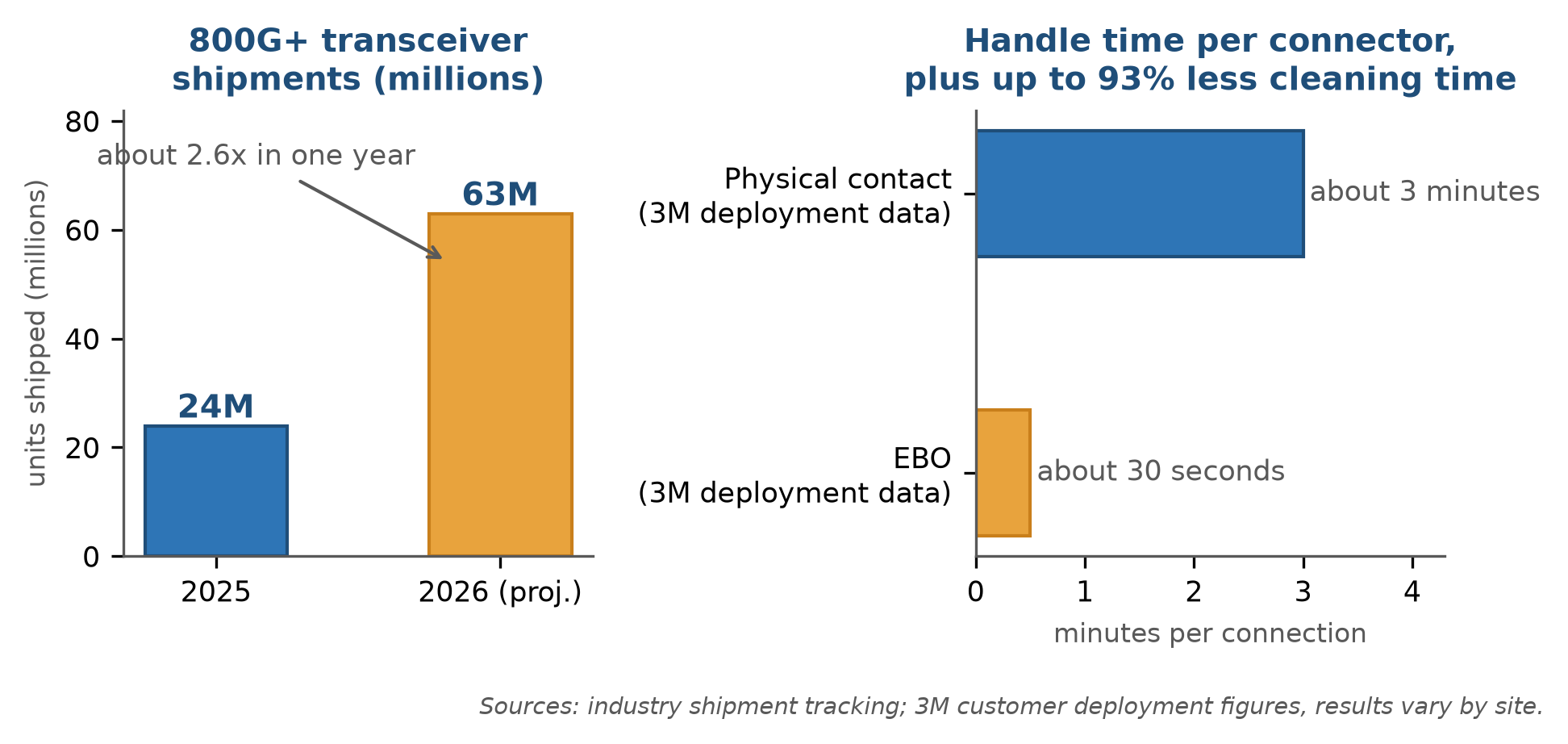
The claimed numbers are striking. In its customer deployment materials, 3M reports cases where handling a physical contact connector took about 3 minutes and an EBO connection about 30 seconds, and it has advertised cleaning and inspection time reductions of up to 93%. We want to be careful on your behalf here: these figures come from 3M's specific customer deployments and test scenarios, so you should not assume every data center will bank the same savings. But the direction is clear, and even a fraction of that improvement changes project math when connections number in the tens of thousands.
Put the savings in crew terms. A hall with 20,000 connection points averaging three minutes of handling per physical contact connector burns roughly 1,000 technician-hours before a single full test session starts. Cut the average to 30 seconds and the same work takes about 167 hours. Even if real projects capture only part of that gap, the difference arrives as weeks of schedule. In AI infrastructure, schedule is the product.
Why did AI, specifically, break the old equilibrium? Classic cloud traffic flows mostly north to south, from servers out to users. AI training traffic flows east to west, GPU to GPU, in massive synchronized bursts across rail-optimized layouts. A single flagship training run can tie together tens of thousands of GPUs whose links all matter at once, because one slow or dirty connection anywhere can throttle the whole job. Speed of light and speed of installation both become competitive weapons. When a rival cluster reaches full training capacity weeks before yours, nobody consoles you with a lower connector loss figure.
The industry has moved from talking to building. 3M says the technology has been in commercial volume production since late 2024, and in March 2026 it announced a U.S. manufacturing expansion that will more than double EBO capacity to meet AI data center demand. In July 2026, Microsoft and 3M announced their strategic partnership, with Azure becoming the first announced hyperscale cloud provider to deploy EBO in its data centers; trade coverage of the deal highlights faster fiber installation with lower labor cost as the core motivation.
By 2026, in other words, this is no longer a laboratory concept looking for a home. It is a product line with production capacity, a standardization effort behind it, and a hyperscale customer running it. The infrastructure around such deployments is familiar territory for us: the optical transceivers that launch the 800G and 1.6T signals, the optical distribution frames where thousands of fibers land, and the network cabinets and open racks that hold it all. What changes with EBO is the connector physics at each of those landing points.
Is EBO Set to Replace MPO?
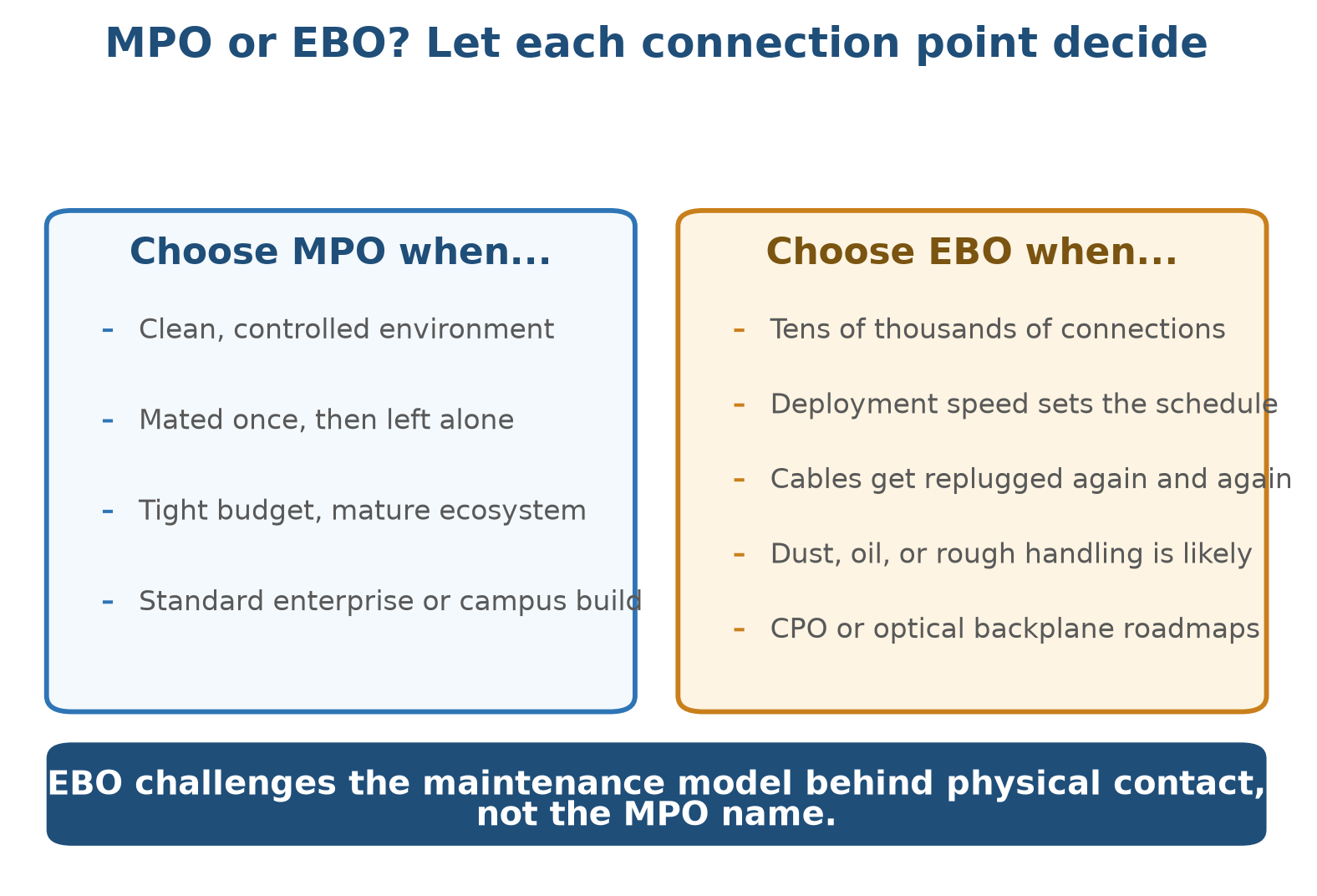
No, and it will not any time soon. The two will split the work. Clean environments, low mating counts, and cost-sensitive builds still favor mature MPO. Massive connection counts, fast deployment, frequent replugging, and dirty or harsh sites favor EBO. EBO's real target is not the MPO product line; it is the inspect, clean, and replug maintenance model behind physical contact.
The honest answer is scenario selection, not a war with one winner. Think in three buckets.
Bucket one: MPO stays the sensible default. If your environment is clean, your connections get mated once and left alone, and your budget is tight, the mature MPO ecosystem is hard to beat. Decades of tooling, test gear, training, and second sources keep its cost low and its supply deep. Most enterprise networks, campus builds, and access-layer fiber will live in this bucket for years.
Bucket two: EBO's value rises fast. If your project involves enormous connection counts, deployment speed is critical, cables will be plugged and unplugged repeatedly, or the site is exposed to contamination and rough handling, the expanded beam trade starts winning. That describes AI training clusters, rapid-build hyperscale halls, and retrofit work in live facilities, which is exactly the terrain vendors aim at when they position expanded beam as high-performance, low-maintenance, plug-and-play interconnect for hyperscale data centers.
Bucket three: the future architectures. If co-packaged optics (CPO), optical backplanes, and dense in-rack optical interconnect keep developing, connectors with low mating force, stackability, and easy servicing will find more doors open. Molex's newest VersaBeam Mini signals exactly where this goes: a 16-fiber expanded beam connector in a 3.5 by 9 mm footprint, aimed at CPO, optical backplane, and front-panel switch applications in AI data centers, with panel densities reaching 3,456 fibers per rack unit.
So the smart question is not "which one survives?" MPO will survive everywhere its cost and ecosystem fit. The smarter question is "what does each connection point in my design cost to install and maintain over its life?" Answer that, and the split decides itself. If you are mapping that mix today, our full fiber optic product catalog covers the MPO side deeply, from cassettes like this ultra-thin MPO/MTP cassette module to the fiber optic adapters that hold paired connectors in panels and racks.
If you want a practical filter for your own projects, ask four questions. How many connection points will this build have? How often will they be replugged or reconfigured over five years? How clean and controlled is the installation environment? And what does an hour of delay or a failed link actually cost the business? Low, rarely, very clean, and little points you to MPO with confidence. High, often, imperfect, and a lot means EBO deserves a pilot, especially in the rows of racks you expect to rewire repeatedly.
Where the Real Technical Barrier Lies
From the outside, an EBO connector looks like a small plastic plug. From the manufacturing floor, it is six hard problems stacked on top of each other: optics, precision molding, micro-structures, mechanical alignment, fiber arrays, and connector design, all fused into one part. We say that with respect, because this is the world we work in every day.
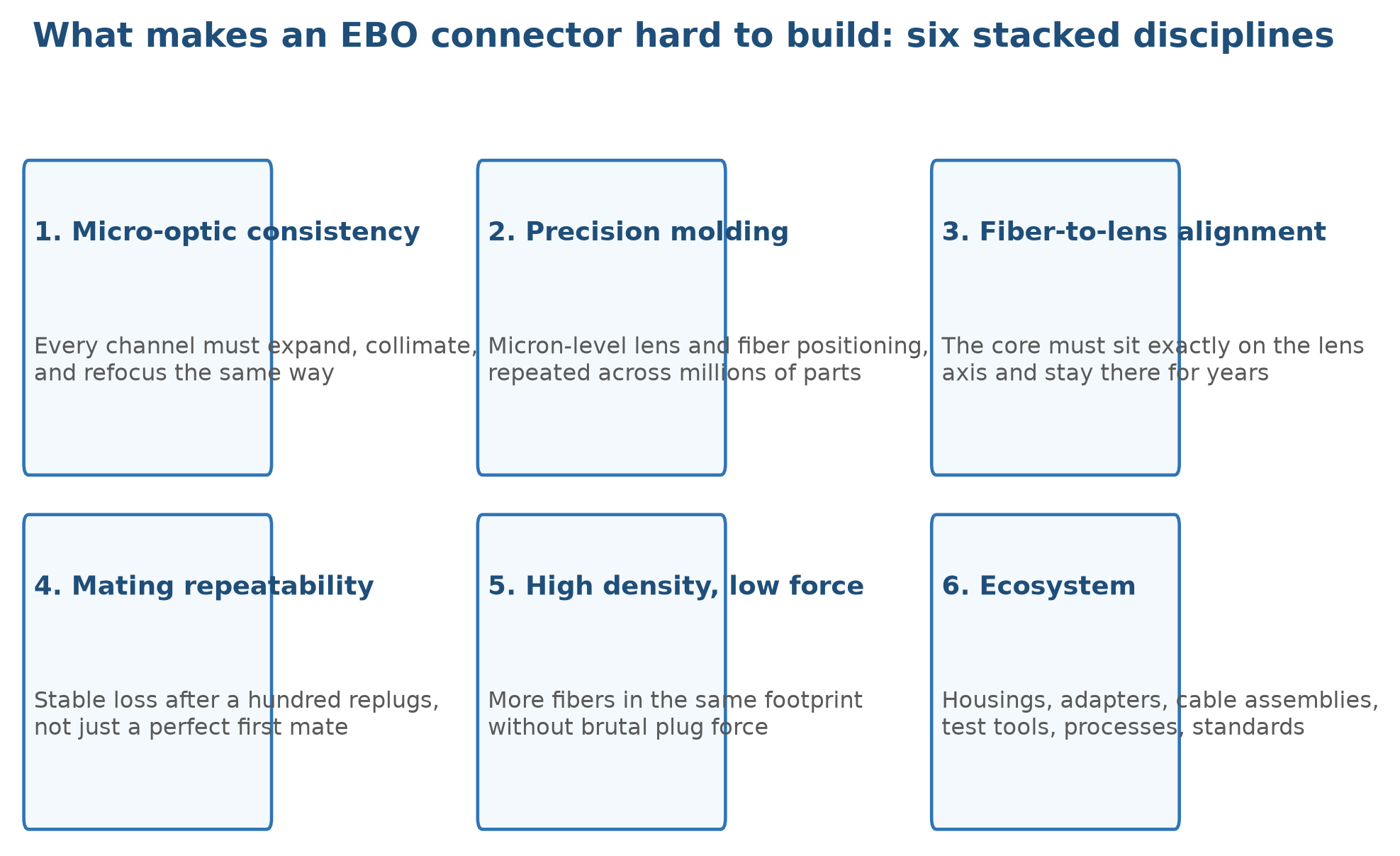
Micro-optic consistency, channel by channel. Every single light path must be expanded, collimated, and refocused correctly, and every channel in the array must behave like every other channel. A lens array where channel 3 focuses a hair differently than channel 9 is a reject, and you only find these things with disciplined, in-line optical measurement.
Precision molding at multi-fiber scale. The ferrule must position 12, 16, or more lenses and fibers with micron-level repeatability, across millions of parts. At these tolerances, tiny molding errors convert directly into coupling loss. This is injection molding at a precision most plastic products never approach, and it is one reason capacity expansions like 3M's are announcements in their own right.
Fiber-to-lens positioning stability. The fiber core must sit at a stable, exact spot relative to its lens, and stay there through temperature cycles, cable pulls, and years of vibration. A beautifully designed lens cannot rescue a fiber that has drifted off its seat.
Mating repeatability, not just first-time performance. Mating well once is easy. Mating well after the 50th or 100th replug, with dust floating around and tired technicians at 2 a.m., is the real exam. This is exactly the repeated-plugging behavior 3M's 100-cycle data is meant to demonstrate.
Scaling to higher fiber counts with low force. 3M emphasizes low insertion force and multi-ferrule stacking capability, and that emphasis is really preparation for higher and higher fiber density. More fibers per connector means more alignment features sharing the same tiny footprint, plus plug force that human hands can still manage in a packed rack.
The surrounding ecosystem. A ferrule alone is not a product. Real deployments need connector housings, adapters, cable assemblies, inspection tools, assembly processes, training, and standards. Building that scaffold takes as long as perfecting the ferrule itself, which is why the multi-source agreement we will discuss next matters so much.
There is a compounding effect that outsiders often miss. These six problems multiply each other rather than simply add. A perfect lens array cannot compensate for a fiber seat that drifts with temperature. Perfect optics and molding still disappoint if mating alignment wobbles on the 100th replug. The manufacturing challenge is holding every tolerance at once, on every part, at volume. That is why connector manufacturing rewards decades of accumulated process knowledge, and why the industry's biggest players treat a new architecture as a marathon rather than a sprint.
Analysts watching the space flag the same picture from the outside: the open question is whether manufacturing scale can keep up with hyperscale demand, and how second sources develop. That question is not a knock on the technology. It is the normal toll booth every successful interconnect passes through on the way from clever to ubiquitous.
We will add one manufacturer's confession: precision at this level is expensive to learn and cheap to lose. Our own production lines use in-line interferometer checks and 100% optical testing, our engineers hold 285 patents, and we still treat every new product ramp as humbling. The same humility applies to anyone scaling lens-array ferrules by the million. If you enjoy seeing how this kind of precision is actually industrialized, take a walk through our connector factory page, or look at how demanding even conventional field-installable fast connectors are to build consistently.
How Far Along Is EBO Industrialization, Really?
EBO has moved from a 2019 technology demo to commercial volume production since late 2024, a capacity expansion that more than doubles output in 2026, an open multi-source agreement with about 60 member companies, and a first announced hyperscale deployment in Microsoft Azure. Cost, interoperability, and long-term reliability will decide how much share it finally takes.
If you only looked at 2019, when 3M first presented EBO publicly, you would see an interesting new connection technology hunting for a market. If you look at 2025 and 2026, you see something much more serious: productization, capacity expansion, standardization, and hyperscale customer adoption, all happening together.
Why does that combination matter more than any single spec sheet? Because a connection technology has to pass five gates before data centers trust it with their builds: performance, manufacturing, supply chain, standards, and customer validation. Fail any one gate and you remain a demo. EBO is now visibly clearing all five, and the timeline shows it:
- Performance: published 12-fiber specs, 100-mating-cycle data, and deployment results from 3M's materials.
- Manufacturing: commercial volume production since late 2024, plus the March 2026 announcement that more than doubles U.S. EBO production capacity.
- Supply chain: a second-source ecosystem is forming. Molex already sells expanded beam connector lines built on 3M's ferrule technology, Sumitomo Electric builds dense EBO multi-fiber connectors on its own fiber manufacturing base, and connector makers such as Rosenberger have joined the EBO MSA member roster alongside dozens of others.
- Standards: the EBO MSA (multi-source agreement), launched by a coalition in May 2026, is building open, interoperable specifications covering multiple EBO connector configurations, so products from different vendors can be mechanically and optically interchangeable. Membership has grown to roughly 60 companies, including Microsoft, Meta, Oracle, Nvidia, AMD, Cisco, Arista Networks, HPE, Amphenol, TE Connectivity, Molex, Senko, Sumitomo, Rosenberger, and Foxconn, and the group presented its framework at ECOC 2026.
- Customer validation: Microsoft Azure, the first announced hyperscale deployment.
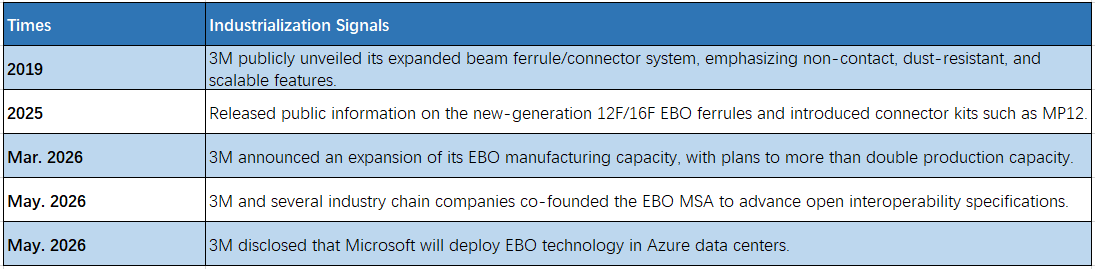
For planning purposes, we read the tea leaves this way. Through 2026 and 2027, expect EBO to concentrate where its strengths pay immediately: hyperscale AI builds, high-maintenance zones, and rapid-deployment modules. Expect the MSA specification releases to be the real unlock for everyone else, because interchangeability is what lets second sources compete on price and availability. Long before EBO becomes a default, it becomes a line item your suppliers should be able to discuss in detail. If they cannot, that tells you something too.
Notice what is still missing from that list: settled answers on cost, ecosystem maturity, cross-vendor interoperability in the field, and decade-scale reliability data. Those four factors, not marketing enthusiasm, will decide EBO's final market share. Our read as a supplier: plan for a mixed world, watch the MSA specification releases closely, and pilot EBO where its strengths pay instead of betting the whole farm.
The Bottom Line: What an EBO Connector Really Sells Is Maintainability
Strip away the lens diagrams and the physics is almost embarrassingly simple. Make the light spot bigger, so the same grain of dust becomes relatively less deadly. Send the beam across a gap, so two polished glass faces never have to touch. Any competent optics student could explain it in an afternoon.
What makes it matter is the scale around it. In an AI data center, nobody's career hinges on whether one connector posts a beautiful loss number in a laboratory. What hinges is whether tens of thousands of connection points can be installed quickly, reworked rarely, cleaned seldom, and trusted to stay stable after repeated plugging. The EBO connector is not really selling "a bigger beam of light." It is selling fewer inspection cycles, faster buildouts, and technicians who go home on time.
The maintenance framing also explains who should care most right now. If you operate one wiring closet, none of this urgency applies to you. If you operate halls of GPU racks, or you assemble the cabling that goes into them, the per-connection arithmetic in this article is your daily spreadsheet. EBO is a bet that the industry's bottleneck has moved from optical performance to operational throughput. The bet looks increasingly well placed, which does not make it a religion; it makes it a tool with a specific job.
That is also why the story keeps escalating. The technology's fate was never going to be decided by optical elegance. It is being decided by maintenance economics, and those economics now include a hyperscaler, a doubling of production capacity, and 60-odd companies writing common specifications.
So here is the sentence we would carve into every buyer's notebook: 3M's EBO does not exist to prove that light can be connected a different way. It exists to solve the deployment and maintenance efficiency of massive optical connection counts in the AI era. Judge every claim, spec, and vendor pitch against that sentence, and the technology becomes easy to place.
Conclusion: What This Means for Your Next Build
Three takeaways worth keeping. First, the EBO connector trades a little insertion loss for a lot of maintainability, and in AI-scale builds that trade is usually right. Second, read specs like a buyer, not a bench engineer: mating stability, dust behavior, mating force, and installed time per connection tell you more than a best-case loss figure. Third, adoption is real but early, so plan a mixed MPO plus EBO strategy and revisit it as the MSA specifications land.
If you are designing or upgrading AI-era fiber infrastructure, we can help you pressure-test the plan. Tell us your port speeds, fiber counts, and loss budget in the form below, and our engineers will reply within 24 hours with component suggestions, from fiber optic cable and MPO assemblies to the newest connectivity options worth piloting. You can learn more about who we are at HENGXANG here, or just scroll down and send us your questions. The form takes two minutes, and it puts a 25-year connector factory on your side of the table.
Planning an AI-era fiber build?
Tell us your port speeds, fiber counts, and loss budget in the inquiry form below. Our engineers will reply within 24 hours with component suggestions, from fiber cable and MPO assemblies to the newest connectivity options worth piloting.
Frequently Asked Questions
These are the questions our customers ask most often alongside our general FAQ page.
What does EBO stand for in fiber optic connectors?
EBO stands for Expanded Beam Optical. It describes a connector that uses tiny lenses inside each ferrule to widen every light beam into a broader, parallel beam that crosses a small air gap between two ferrules, instead of pressing polished fiber end faces together. 3M pioneered the current data center version, other vendors like Molex build on the same idea, and the EBO MSA is standardizing it across about 60 member companies.
Do EBO connectors really never need cleaning?
No, and be suspicious of anyone who says otherwise. Expanded beam connectors are less sensitive to small particles because the light spot is wider, so dirt covers a smaller share of the beam. But every optical system still needs sensible cleanliness control, and badly contaminated lenses will still hurt performance. The honest claim is fewer cleaning and inspection cycles, not zero.
How does EBO insertion loss compare with MPO?
Per 3M's MP12 connector kit data sheet, single-mode EBO runs at 0.35 dB typical (0.70 dB maximum) insertion loss with at least 55 dB return loss at 1310 nm, while multimode runs at 0.20 dB typical (0.30 dB maximum) at 850 nm. A perfectly clean, high-grade MPO can post lower typical loss, but MPO performance depends on that cleanliness at every mating, whereas EBO is designed to stay stable across a hundred replugs in imperfect conditions. Judge both on repeatability and maintenance, not one bench number.
Will EBO connectors replace MPO in data centers?
Not soon, and possibly never entirely. Clean environments, low mating counts, and cost-sensitive builds still favor the mature MPO ecosystem with its deep tooling and second sources. Huge connection counts, rapid deployment, frequent replugging, and dusty or harsh sites increasingly favor EBO, and future CPO and optical backplane designs may lean toward it too. The real shift is from one maintenance model to another, not from one product name to another.
Can I buy EBO connectors today, and who makes them?
Yes, though the ecosystem is young. 3M has been shipping EBO in commercial volume since late 2024 and is more than doubling production capacity; Molex sells VersaBeam expanded beam connector lines for hyperscale builds; and the MSA's 60-odd members are working on interchangeable specifications. For most projects today, MPO remains the practical default, so the smartest move is a conversation about where each fits in your plan. Send us your requirements in the form below and we will map it with you.
Interested in our products?
Get a Quote